Forgotten huts

May 2025

Read more from

May 2025

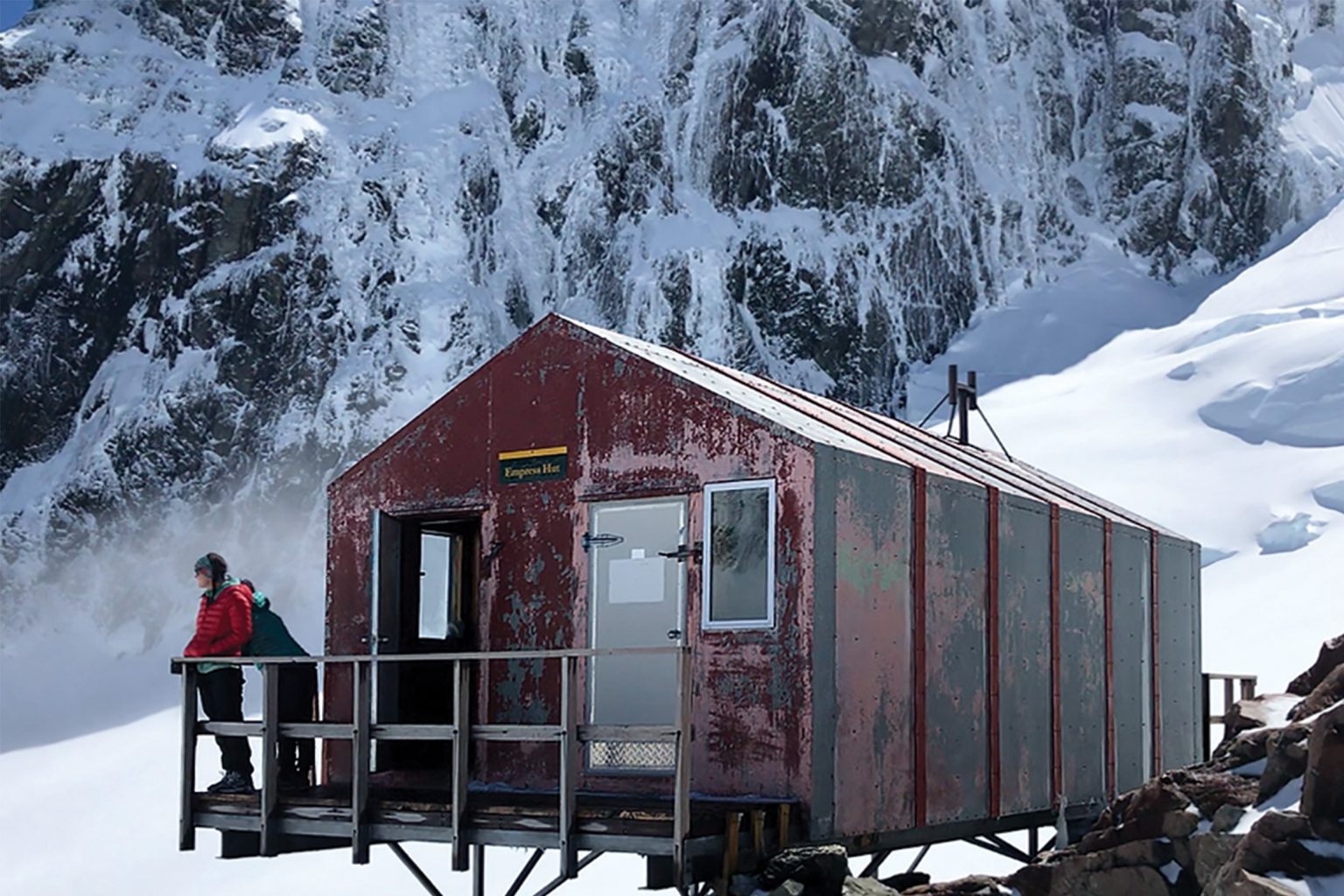
Empress Hut, at head of Hooker Glacier, sits in the shadow of Aoraki Mt Cook. Photo: Alastair McDowell

Old trampers never die, they just trail away. What happens to old huts when they pass their use-by date? Wilderness visits a handful of old huts that have been renovated or repositioned at new spots to be ready for their own twilight years. 

Empress Hut, Aoraki Mt Cook

Canterbury Mountaineering Club built this hut on the Empress Glacier in 1953. It was located on the site of the old upper Hooker bivouac and was a long day’s walk up the Hooker Valley. Material for the hut was air-dropped onto the glacier. In 1994 it was replaced by the current DOC hut, which continues to shelter mountaineers in the shadow of Aoraki/Mt Cook.

Today visitors can enjoy Empress Hut Mk1, which is on display behind the DOC visitor centre at Mount Cook Village.

Syme Hut, Te Papa-Kura-o-Taranaki

The original hut sited at 1951m on Fanthams Peak was built by Mt Egmont Alpine Club. This simple corrugated-iron 10-bunker remembered the club’s founder Rod Syme, who summited the volcano more than 200 times and was the club’s bulletin editor for 53 years.

The hut was prefabricated in late 1929 and materials were lugged up Fanthams Peak. It was opened in April 1930 in the presence of 300 people.

In November 1946 the hut was completely buried in snow and in 1953 an interior telephone was installed. Then in 1966 the Park Board threatened to demolish Syme Hut, but the Conway family completed major repairs that ensured the structure could withstand the elements for another 30 years. Eventually, a new Syme Hut was built nearby in 1988.

In 1997 the old hut was dismantled, and reassembled as a historic display in the Dawson Falls Visitor Centre.

Luna Hut was the first hut to be transported by helicopter. It’s now on a farm in Tapawera. Photo: Ray Salisbury

Luna Hut, Tapawera

This small four-bunker reeks of history. Luna Hut was NZFS hut #431 and was the first in New Zealand to be transported on-site by helicopter. During the winter of 1958, four huts were pre-cut at the Golden Downs workshop, transported to Karamea on the West Coast, then flown in by a Bell-47. Luna Hut sat on the true right of the Karamea River near where Trevor Carter Hut is located today, west of Mt Luna.

Ron Turner recounted a particular difficulty experienced as the hut was being built: “The sandflies were particularly thick, driving everybody mad. We must have killed at least  10,000 of them, but about 40,000 came to their funeral.”

This hut has been host to several dramas. In the winter of 1968 a trio of schoolboys embarked on an ill-fated tramp along the Wangapeka Track. Two succumbed to hypothermia in a blizzard on Biggs Tops. The third retreated to Luna Hut, where he was eventually rescued by renowned helicopter pilot John Reid.

In the autumn of 1977 local bushman Snow Meyer took his young bride to Luna Hut for their honeymoon. Unfortunately, heavy snowfalls saw the couple trapped inside for an interminable six weeks. The red-bearded bushman was a fine all-rounder, capable and competent, but was accountable to no one but himself. He was also prone to bouts of psychotic behaviour. His marriage didn’t last long.

The hut was removed in 2003 and transported by truck to Harry Hancock’s farm in Tapawera. Harry renovated the building, which sits quaintly in the bush by a picturesque lake. Harry died in 2014 but his family still runs the farm. Visiting friends sometimes sleep in Luna Hut, which has survived beyond its expected lifespan.

Pfeifer Bivouac, Canterbury

The famous Kaikōura Coast Track is a private walkway across farmland in Northern Canterbury. Near the second night’s accommodation you may notice the original Pfeifer Bivouac tucked away behind the farmhouse. When DOC replaced the hut, in January 2008, the Handyside family transported the dilapidated building across the motu to become a playhouse for their grandchildren.

This two-man bivvy was originally built by NZFS in 1962 on the slopes below Mt Pfeifer, north-east of Arthur’s Pass. It was a standard B55 design – a wooden frame clad in iron. The replacement building features polystyrene under-floor insulation, which kea have discovered. They have shredded it methodically into thousands of small particles.

Trevor Carter Hut Mk1 lives out its twilight years on the Nelson polytech campus. Photo: Ray Salisbury

Defiance Hut, Franz Josef 

Pioneering guides Peter and Alec Graham once hauled camping equipment up Franz Josef Glacier for their clients. Following a successful request for funding from the Department of Tourist and Health Resorts, Defiance Hut was constructed in 1913. It sat on a moraine terrace above Harpers Creek in a bush setting, with grandstand views of the main icefall. The simple wood and iron building was divided into men’s and women’s bunkrooms, provided accommodation for 12 on kapok mattresses and had an open fireplace.

Overnight parties would signal their safe arrival by igniting newspaper at Flare Rock, a nearby outcrop. Friends in the village below would reply to this primitive form of communication.

As Franz Josef Glacier receded, part of Defiance Ridge began to crumble. In 1936 the hut was reassembled further around the ridge crest, but by the 1950s this site was also threatened by erosion. A replacement hut was built and, in 1978, Defiance Hut was relocated behind the old Franz Josef Visitor Centre for public viewing. 

In June 2020, the hut was craned onto a truck and taken up-valley to new piles beside the car park. Today the old-timer is open for visitors to experience the musty ambience of an early mountain hut.

Broome Hut is now 60 years old and can be visited at the early settlers’ museum in the main street of Onga Onga. Photo: Ray Salisbury

Broome Hut, Onga Onga

This classic SF70 design hut was built in 1964 by the Forest Service (NZFS) and positioned near Big Hill Station in the north-eastern corner of the Ruahine Range. Poor road access made the hut redundant and it was removed in 1995 to be relocated at the early settlers’ museum in the main street of Onga Onga, a tiny town in Hawke’s Bay. The hut is in its original state and is a time capsule of the frenetic hut-building that the NZFS undertook from the 1950s to the 1970s. Like many others it was painted orange to be visible from the air. Inside are relics of the era such as gas lanterns, billies, camp ovens and mountain radio.

About the author

Wilderness

More From Features

Related Topics

Similar Articles

The Top 6 Trips in Arthur’s Pass

Four decades of shelter 

Fiordland Fun for the Whole Family

Trending Now

DOC’s best huts

Apply for the Shaun Barnett Memorial Scholarship

Upgrading to ultralight without replacing everything

Walk1200km‭ ‬in 2026

Tapuae-o-Uenuku, Inland Kaikoura Range

Subscribe!
Each issue of Wilderness celebrates Aotearoa’s great outdoors — written and photographed with care, not algorithms.Subscribe and help keep our wild stories alive.

Join Wilderness. You'll see more, do more and live more.

Already a subscriber?  to keep reading. Or…

34 years of inspiring New Zealanders to explore the outdoors. Don’t miss out — subscribe today.

Your subscriber-only benefits:

All this for as little as $6.75/month.

1

free articles left this month.

Already a subscriber? Login Now