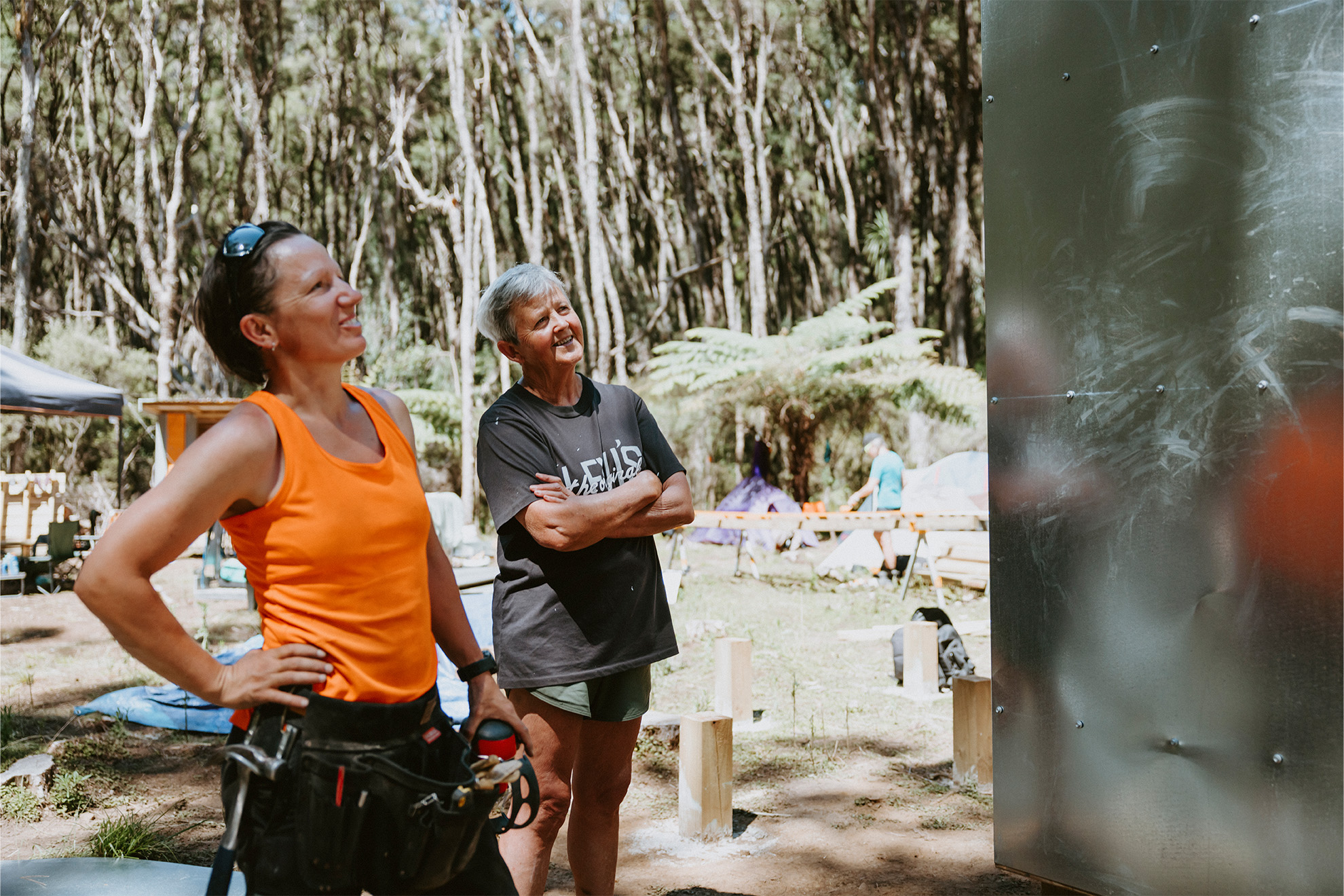
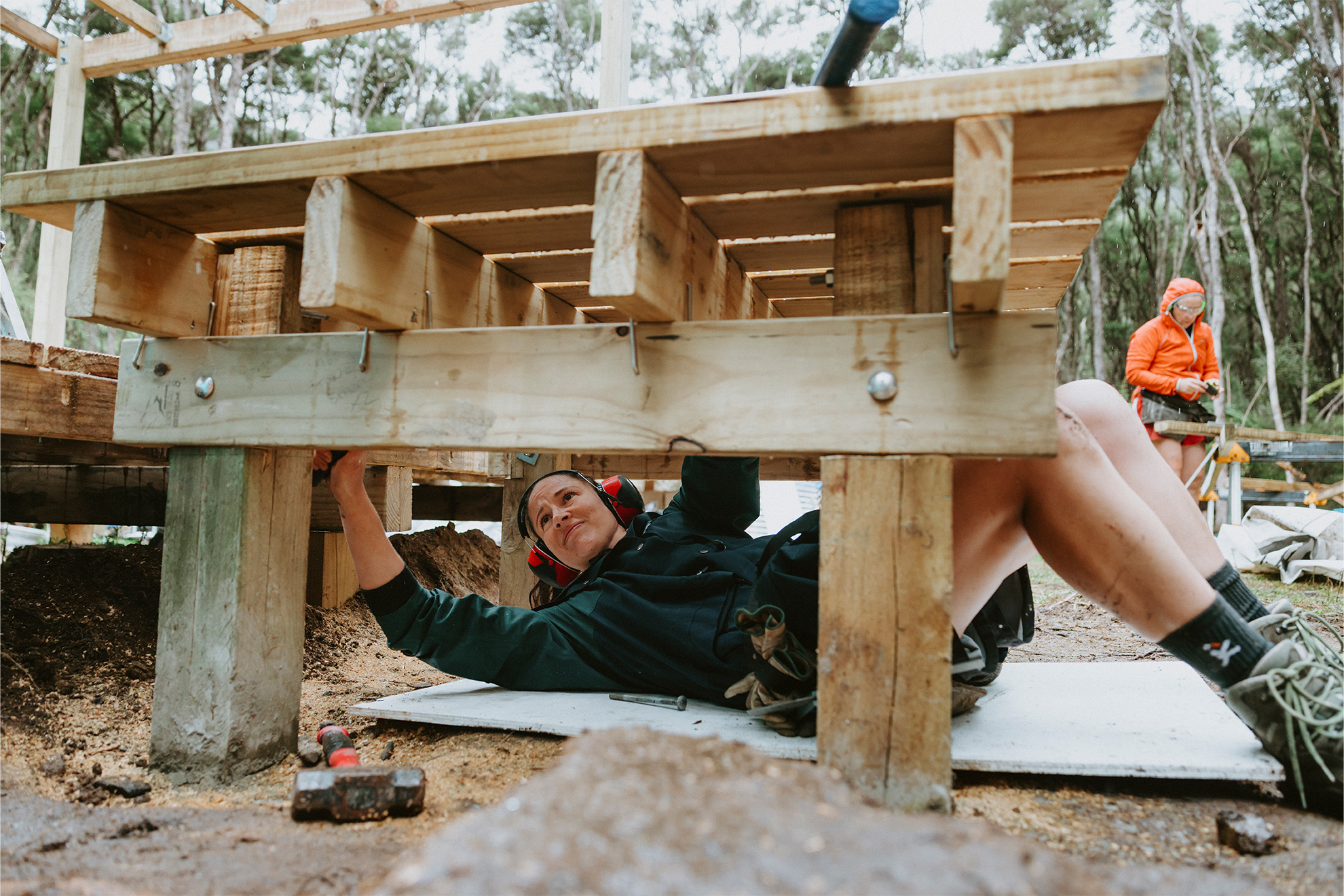
Emma, still going strong following the previous day’s digging of a 1.5m deep long drop then erecting the toilet with Wellington lawyer Sally Neal, was now doing the technical measuring and levelling stuff while guiding newbie me.
“It’s super to be able to give back to the backcountry in a voluntary capacity,” Emma says. “I’ve also learned an amazing array of building skills and the confidence to apply these in practice. And it’s the other volunteers who make these projects so special. The human connections are especially cherished.”
Later, other women helped us finish our cladding, now wearing headlamps in the dying light. This is how the project rolled: supporting each other, building friendships and learning skills.
The others were on day five of a marathon nine-day stint when I arrived, having walked the new track they’d cut instead of helicoptering in with them, along with the timber, iron and old hut in all its parts. The track descends 800m through old pines, then thick, regenerating scrub to the river. It is toe-crushingly steep. I installed track markers en route and gained huge respect for those who had spent more days than they’d expected lugging a chainsaw, fuel, loppers and camping gear to open the track up.
To be honest, I’d been unsure about joining this project. I expected a bunch of staunch, qualified tradies and here was me, a novice. It turns out that, apart from Megan, there was not a single tradie among them. Instead there was a teacher, an engineer, a part-time actor, a college student, a policy advisor, a tour guide, two lawyers and one woman working towards her pre-trade building course. No building qualifications; but staunch, definitely.
Some had met on previous BCT jobs and pondered how neat it would be to take on their own project. So this wasn’t any hard-nosed feminist thing, just a bunch of women building new friendships with a can-do attitude, and looking to gain more skills and confidence by doing it for themselves.
People may remember the hut as Comet Hut. It had been seriously vandalised at its road-end site, and when DOC’s Malcolm Lock suggested shifting it to a new site, Megan, as BCT North Island project manager, grabbed the chance for the women. The hut’s original name, Komata, also the name of nearby Komata Trig, has been reinstated.
The plan was to helicopter the building to a nearby riverside flat to become a base for rafting, fishing, hunting and pest control.
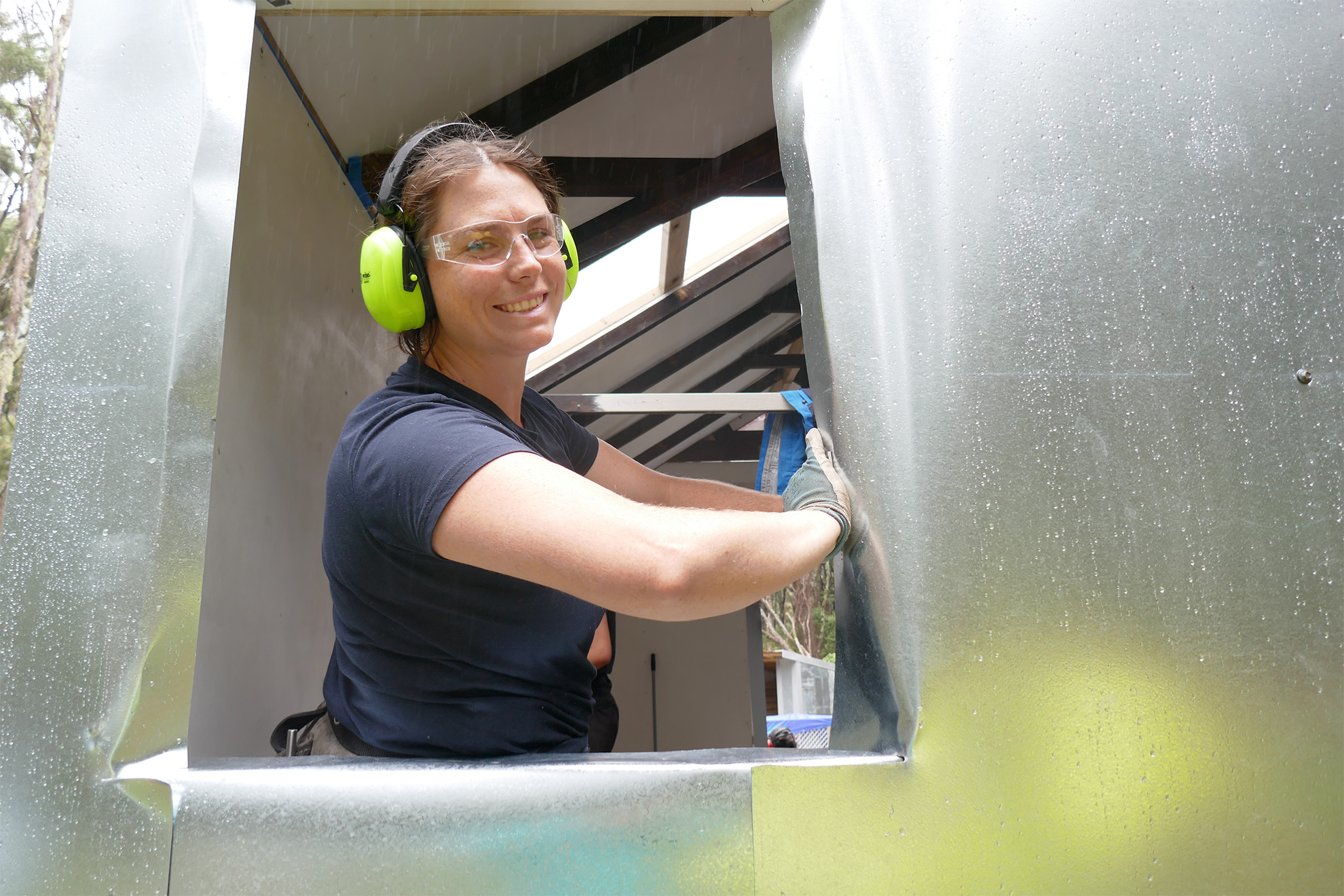
But Geotech engineers preferred a terrace 30m higher, one covered with tall kānuka forest. You could call this the project that grew. Now, the women had to clear the kānuka to make room for the hut. Cutting through such hard, chain-blunting wood was not easy, but it did create a massive firewood supply for future hut users. Weeks later, Cyclone Gabrielle’s rain inundated the lower flat.
The project grew some more when it was realised that Komata Hut was in a bad state: battered and shot at, with only the floor and some framing, trusses and roofing being of any use. Gary MacDonald (of AFM Building) opened up his Napier workshop to the women. Here, they built new framework, constructed flat pack kits for the woodshed, toilet and tank stand, and pre-painted the ply for the internal walls. Gary was the project’s licensed building practitioner. He also mentored the women and loaned them his tools.
The previous December three of the team had joined Megan to install the hut foundations. It was another epic few days recalls teacher Emma Martindale, who’d already been at the coalface for both the site and track-clearing jobs. “Digging holes through rocks and roots then concreting the piles was such grimy, dusty work, but we laughed and sang and learnt new skills like how to use a nail gun safely and calculate Pythagoras’s theorem to set rectangles.”
“Those girls worked their butts off, learned a bunch of new stuff and picked it up like pros,” adds Megan. “I’m not sure I’ve ever seen a crew set piles so precisely.”
The learning and hard yakka continued in February, dawn until dusk and later some days. First, the women broke the old hut down, braced its floor and bundled framework and iron into flatpacks ready to be flown to the new site. There was a hold-the-breath moment, then celebration, when pilot Joe Faram lowered the old floor on a rather long line directly and safely onto its new bearers.
When I turned up, there stood a hut frame, wrapped with underlay. The tiny clearing was strewn with timber, iron, cement bags, ladders, scaffolding, paint, tools and tents. It was raining the next morning, but by then, the hut’s roof and walls were in place, so we sat inside to plan the day’s tasks.
“Look at you guys,” said a rather proud Megan. “You have literally built a hut from the ground up and here we are, it’s raining and we’re sheltering inside our hut.”
By the time the rain had stopped we had a new veranda to sit on. When I left, we’d put in four more piles for the tank stand, the fireplace was being installed, bunks built and exterior painting had started.
(Everyone had a say in the colour scheme. Pink was contentious – “a gender stereotype, nope!” The consensus was to go simple and strong. Dulux Mārahau and Moorhouse Street were duly voted in.)
For engineer Sarah Millar, Komata was her first BCT foray. “I went to a roadshow where Megan was calling for volunteers,” she says. “Before I knew it, I was on the first Komata track-cutting trip. It was such hard work! Then those nine days on the hut site were huge for me.
“I was well out of my comfort zone, but clear instructions from Megan helped. She leads by example, she also works incredibly hard and I found that I rose to that challenge.”
Sarah’s daughter, Bella, also joined the team and helped build the deck.
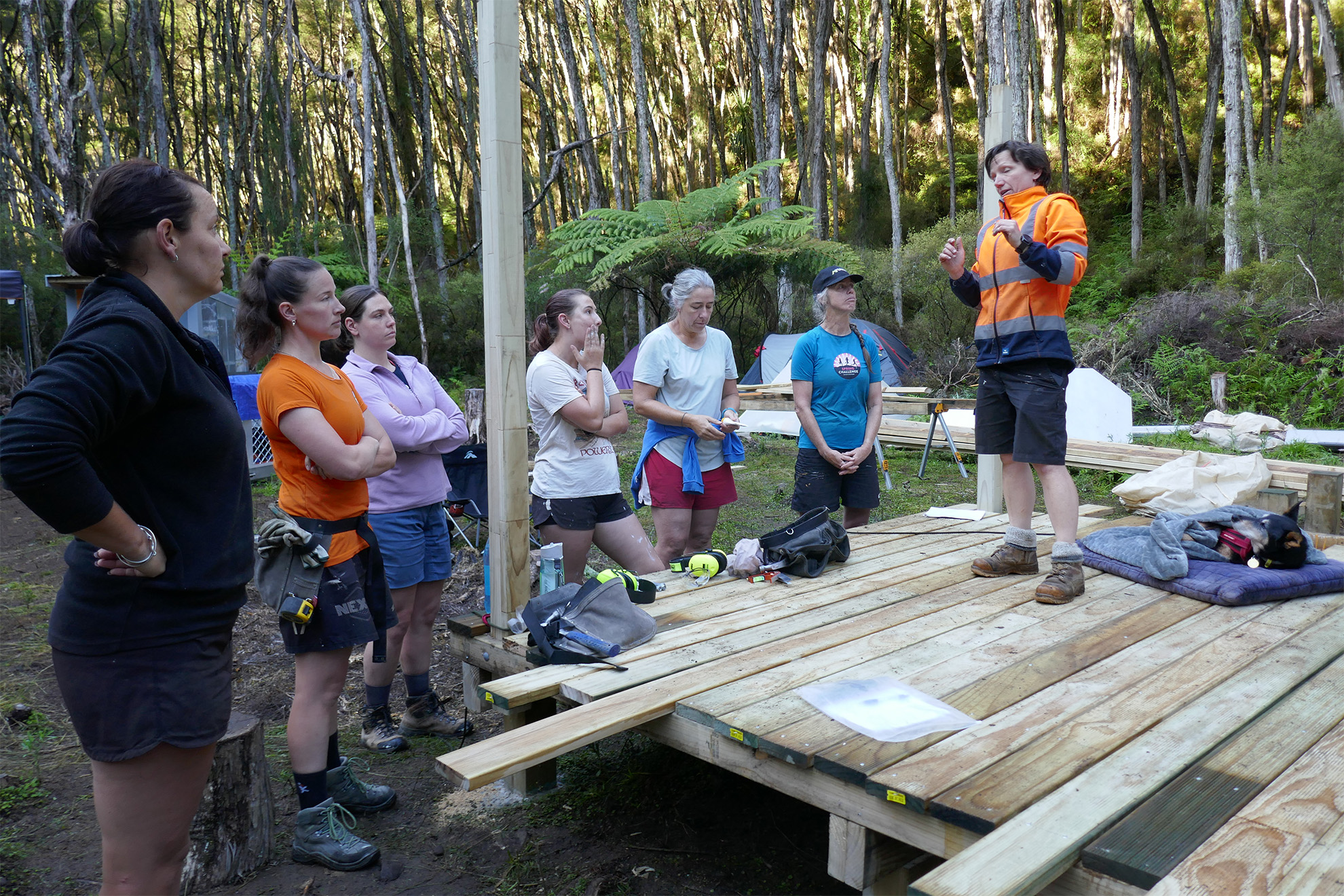
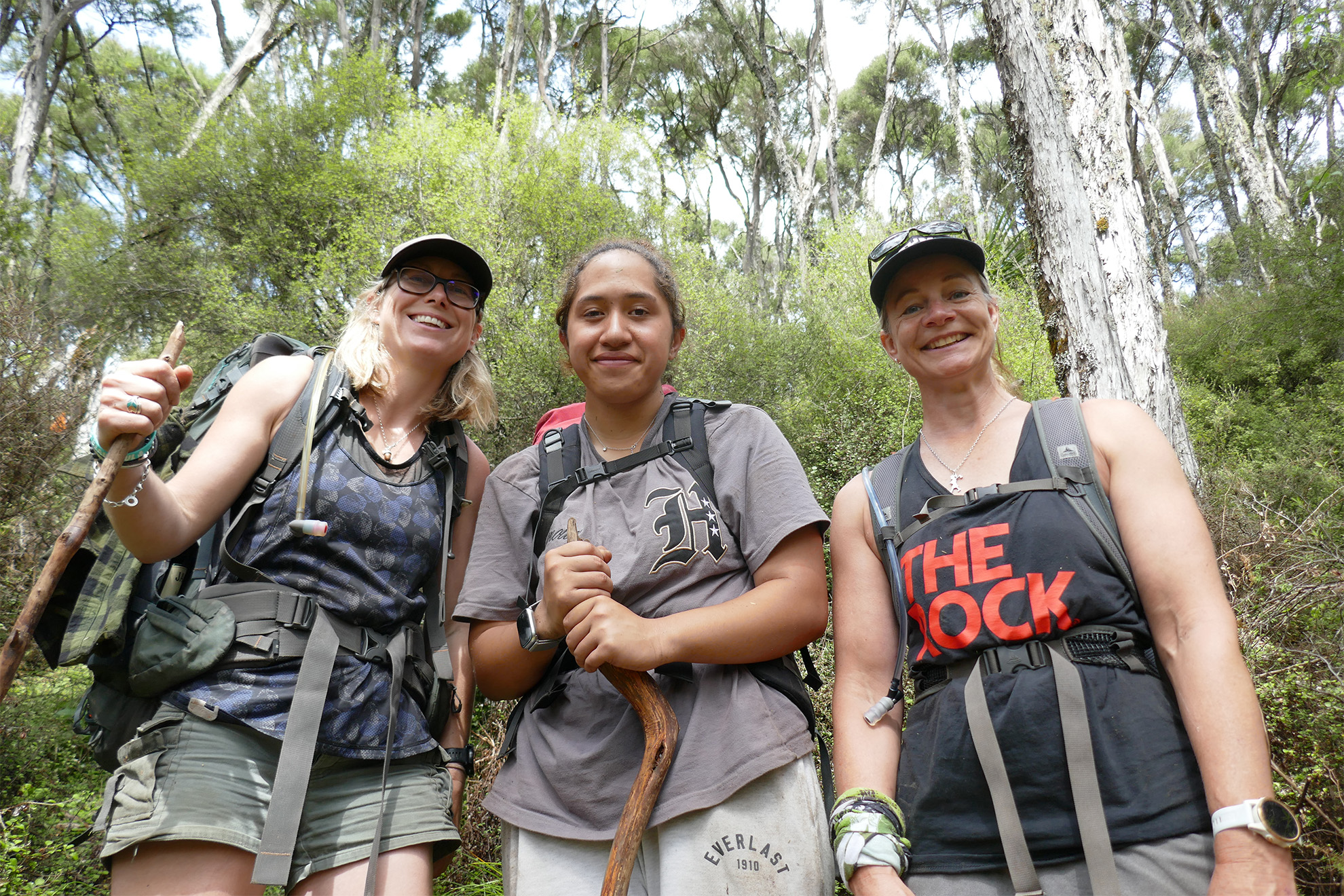
“Part way through screwing down the decking timber, Bella shoulder-tapped me, jumped up and down on the deck and said quietly, ‘We built this, Mum’. It was such a special moment,” Sarah recalls. “I’ve come away immensely proud of the work Bella and I did on the deck, and that Sally and I did on the hut lining.”
Likewise for Sally, who agrees that measuring tetris-like bits of ply to fit awkward angles around the old hut’s trusses was a painstaking but intensely satisfying challenge. A veteran of several BCT projects, Sally has loved the opportunity to learn skills and meet other like-minded women. “I think it’s safe to say, there’s some lifelong friendships in there,” she says.
Sally says her happy place is being in the bush: “In my day job I’m behind a computer all day, so it’s a refreshing change to be in a physical role with a tangible result at the end of each day. And being able to create a space for others to enjoy is very special.”
For Emma Martindale, the project has also been a great place to meet like-minded women, to be her authentic self without judgement, to learn new skills in a safe environment and to get into parts of the ngahere that she’d probably not go to on her own.
A final weekend blitz in March saw the job completed; spouting up, water tank in place, bunks installed, floor sanded – but these women aren’t letting go of this place any time soon. They are taking on the ‘Community Agreement’ for future hut and track maintenance.
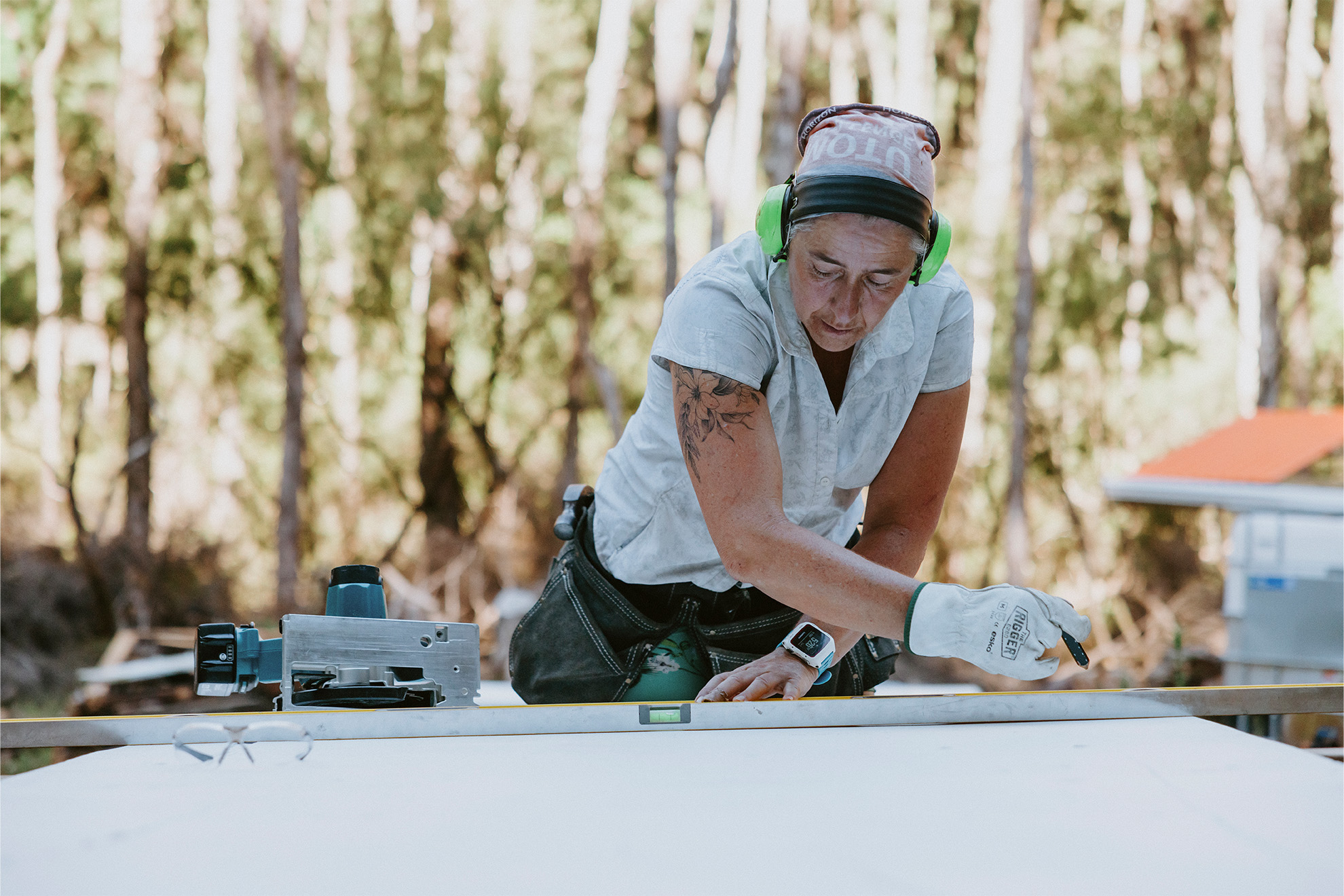
“Contorta pine control and benching the steep track to the river are also on the agenda,” says Sally. “This project has been a huge labour of love for us and it’s special to be able to continue that.”
Megan plans a river trip for the team. “It’s a beautiful stretch of gorges and grade 3–4 rafting,” she says. “Watching this project come together has brought immense pride and satisfaction for me. What a journey it’s been.
“These women have done such a good job. They should be incredibly proud. I think Gary, who’s been an amazing supporter, would be happy to have any of them on his building crew. He couldn’t believe how much we got done in those nine days.”
But it’s not just about huts and tracks. “It’s about the community we’re creating,” says Megan. “People are learning new skills, making friends, having experiences and opportunities they wouldn’t have had before. I’m really hoping in the next year or so that some of the women pick up their own projects.”
Team Wāhine is now keen to see Komata Hut in use. Walking access starts at the end of Comet Road, and the new track turns off the Shutes Hut Track, just past Komata Trig. Allow 3–4hr. River access on the lower Ngaruroro from Kuripapango is a grade 3+ to 4 for experienced paddlers only (the river gets even gnarlier below the hut site). The hut sleeps six, and bookings aren’t required.
While the BCT has traditionally been largely funded by DOC, it is becoming increasingly reliant on support from other sources. The Komata Hut wāhine volunteers acknowledge the support of Pub Charity, Steel and Tube, COLORSTEEL, Dulux (for paint and documentary funding), Thermakraft, Wagener Stoves and Tumu Napier (including $1500 for kitting out the team with tools and tool belts).