


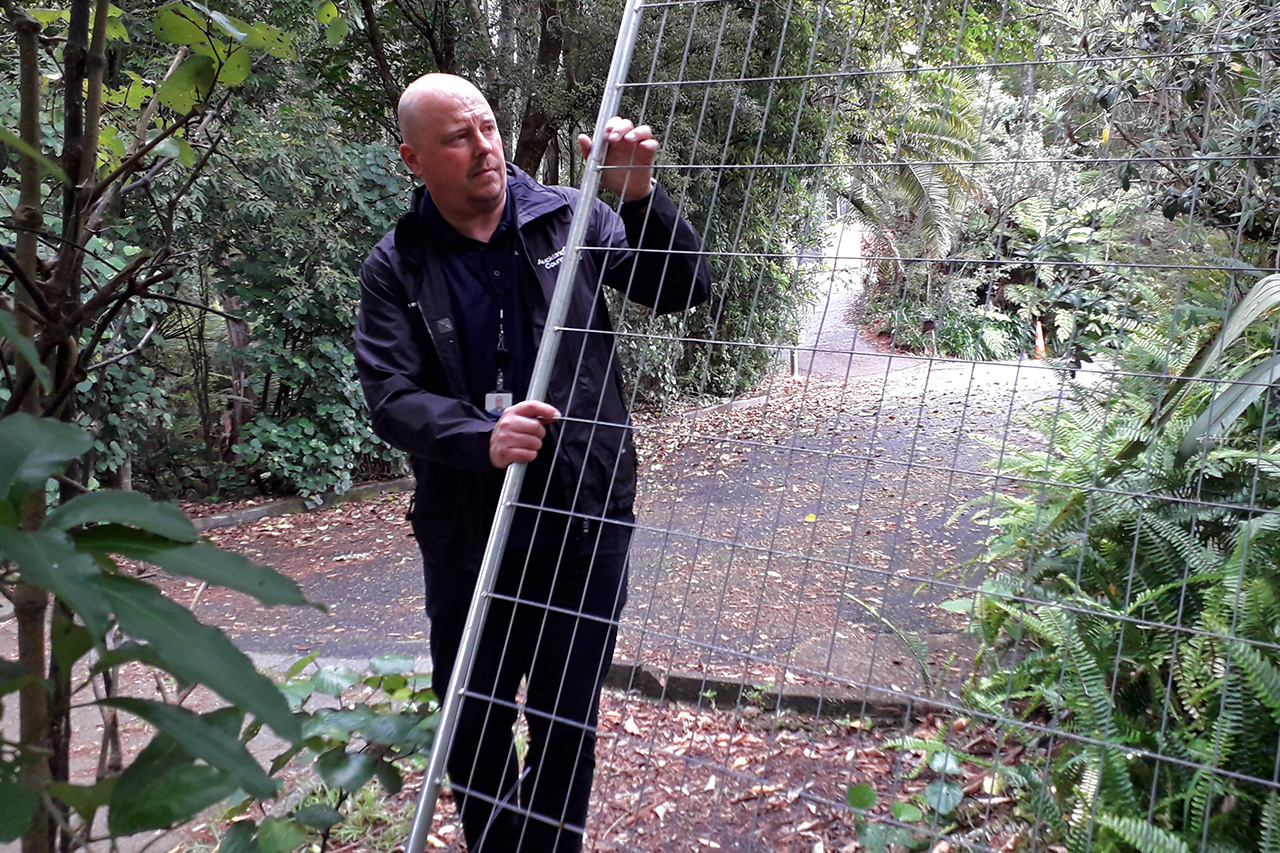
With so much at stake, compliance is taken seriously and in a landmark case, an Auckland man was prosecuted late last year for breaching the bylaws – the first such case to go before the courts. Though a verdict hadn’t been reached at the time of print, Wilson was hopeful of a conviction for the three trespass charges issued against the defendant.
“It will send out a strong message that we’re serious – it’s not just a fluffy education role,” he says.
Overall, Wilson believes compliance is improving. The majority of people using the Waitākere and Hunua regional parks do stick to the open tracks, and those who breach the bylaws regardless likely won’t go undetected for long, especially the locals, who are identified quickly.
“We have overt cameras monitoring activity in car parks, and the ability to place covert cameras in the forest to detect breaches,” Wilson says.
Cars parked near closed tracks are also recorded, and footprints leave clues as to where more surveillance is required.
Maintaining the spread may be the only way to save kauri if a cure isn’t found, and Wilson knows the importance of his role in the jigsaw puzzle of the pathogen.
“I’m not out there to cure it – the scientists can do that – but in the meantime, we do everything we can to preserve them,” he says.
In the last decade, senior parks ranger Stu Leighton has noticed a marked increase in the number of people wanting to get out and enjoy Auckland’s regional parks.
“It’s wonderful to see people connecting and valuing the access they have, but being able to access the forests is a privilege and something we need to have protocols and rules around,” he says.
With more walkers and fewer tracks open, there are fewer opportunities to spread out, and several popular Waitākere tracks are recording huge numbers.
“When people walk a track, they only see their individual impact, which is small – but multiply that by 300 to 400,000 people a year, and that tiny impact of an individual can have a big impact,” Leighton says.
“The area has soft clay and high rainfall, so the natural surface of the track can really deteriorate.”
Leighton looks after track building, a job that requires a metre by metre inspection of tracks to assess the number and size of present kauri, the topography and hydrology – how water moves across the site. No two tracks are the same, and there is no one-size-fits-all formula for track upgrades, he says.
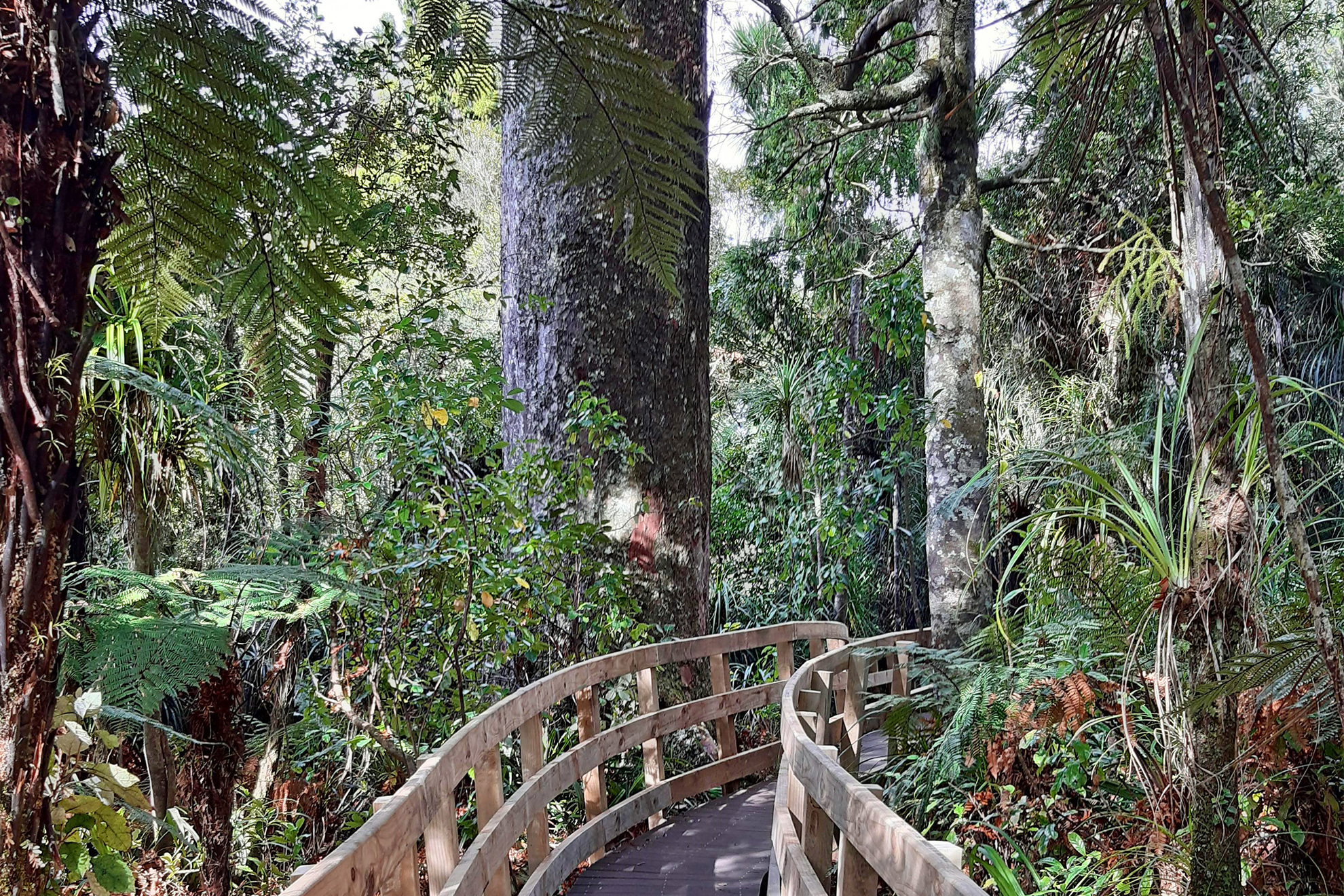
A safe track is designed to protect vulnerable kauri roots. It should be dry underfoot, boardwalked or raised, and it should avoid crossing kauri drip zones – the space directly below a tree’s extended branches. Workers follow rigid protocols to ensure minimal impact.
“We’ve had to figure out ways that workers won’t be moving contaminated soil, so all gravel or material has to come from clean, approved sources,” he says.
All gear and tools have to be cleaned and inspected before entering a site, and full cleaning is repeated between kauri zones separated by streams or gullies, to ensure the soil around roots doesn’t mix.
There’s more to keeping kauri healthy than quarantining trees, Leighton explains.
“The disease doesn’t operate in isolation, so the more we can do to protect the health of the forest, the better, as they’re already under a lot of pressure.”
If kauri have their roots damaged by walkers, or are suffering from a drought, they become more vulnerable to the pathogen.
Leighton is happy with how track upgrades are progressing, and says by the end of summer 2021, “decent lengths” of the 75km Hillary Trail will be open – including the Omanawanui and Pururi Ridge tracks.
“Optimistically, with everything going swimmingly and all the stars aligning, we will have the full Hillary Trail open in late summer 2022,” he says.
While the Hillary Trail appeals to a hardier minority of park users, public engagement has shown people want three ‘L’s in their local walking tracks, regional parks manager Rachel Kelleher says.
“They want ‘links’ to iconic destinations and other tracks, they want ‘length’ and they also want ‘loops’,” she says.
Trying to find the right balance of tracks to keep every park user happy isn’t easy, but Auckland Council’s Waitākere Ranges track re-opening plan is making good progress, with many popular tracks re-opened, or under construction.
A major challenge has been in trying to please those focused on one favourite track. “We try to look at providing an equitable range of recreational opportunities across a geographic area – not any one person’s favourite track, but a safer option that provides the same kind of experience,” Kelleher says.
In Waitākere forests, there are areas of heavy infection and others of pristine kauri – both of which are largely still out of bounds for walkers. Add the resilient Hunua Ranges Regional Park to the mix, and you’re left with a job requiring vastly different management approaches for each location. The priority is stopping soil from moving along the network.
“We have areas that are non-diseased so we need minimum movement within the forests, and in and out of the forests,” Kelleher says.
Public views on dieback management range from those who think the emphasis should be on limiting all forest activity to those who believe there should be no intervention at all – let the trees fall where they may.
Kelleher says the council’s approach is to act on the best information available to manage the disease and do it in a way that recognises recreation and conservation elements.
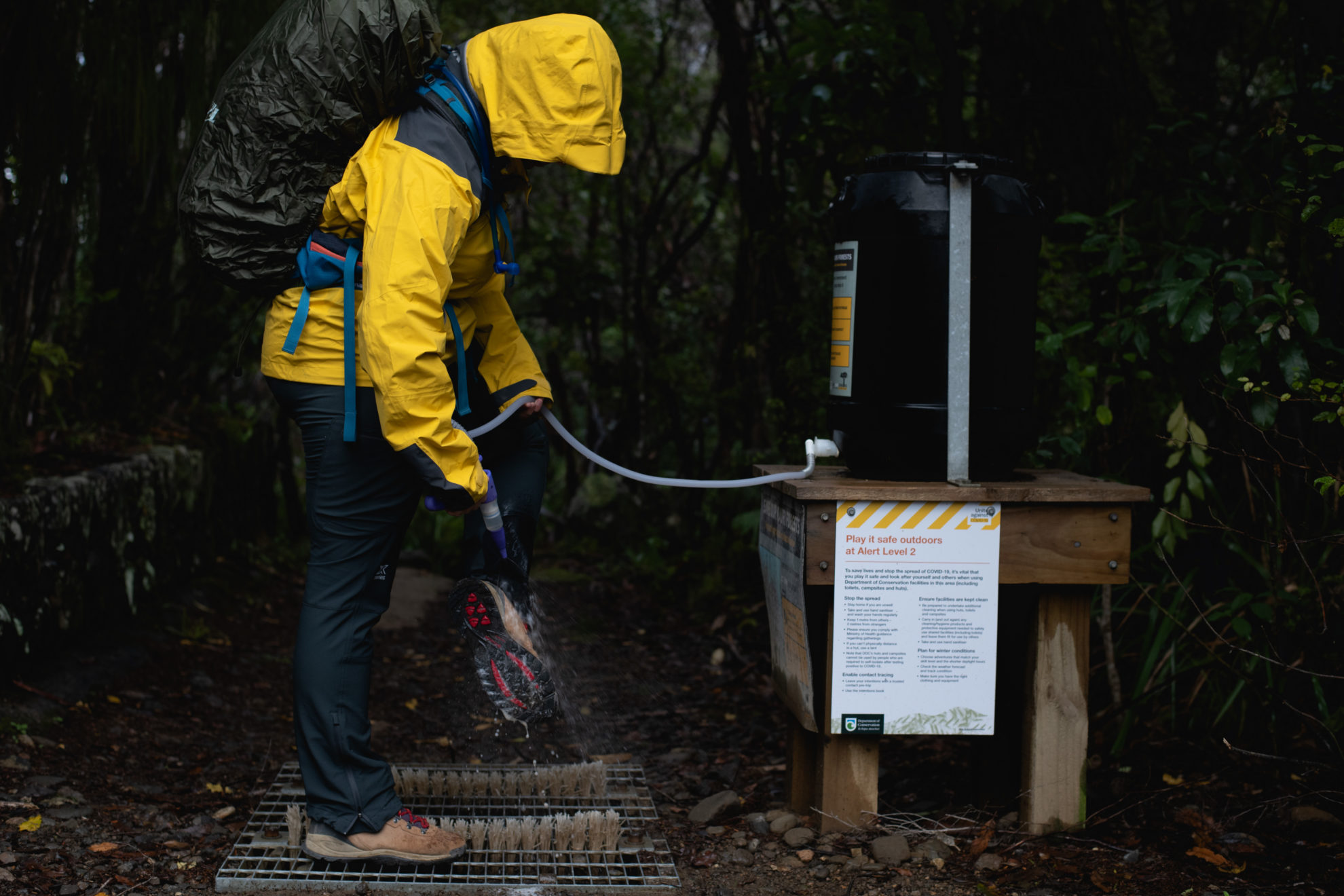
While keeping the parks closed would be the safest option for kauri, council strikes a balance for the sake of public recreation, implementing good hygiene stations and restricting access where necessary.
“We’re dealing with something we don’t have all the answers for, so we put strategies in place that minimise risks,” she says. “You could draw comparisons to wearing masks and good hand hygiene – they’re all things you know will help with COVID, but you also know they can’t 100 per cent guarantee you won’t get exposed.”
Due to the long latency period of the pathogen, Kelleher says it may take some time before the benefits of the track closures are seen – the same way COVID cases were expected to climb after New Zealand went into lockdown.
“Trees can appear healthy when they’ve got the disease, and it takes some years for symptoms to be expressed, so visual surveys may not pick it up,” she says.
“It’s realistic to expect there will be an increase in disease prevalence.”
Biosecurity team manager Lisa Tolich admits it can be tiring to work in a field with no foreseeable light at the end of the tunnel.
“One of the things I need to remind myself to do is reconnect back to the ngahere (forest), and remind myself why we are here,” she says. “When you’re confronted with the devastation of a canopy collapse or you’re out in a healthy kauri area, you see how important they are to the ecosystem.”
Kauri is a keystone species, meaning they set the tone of the forest around them.
Scientists often use the term ‘kauri ecosystem’ instead of kauri, because of the number of species that depend on the giants.
“It’s fascinating the dynamic they have,” Tolich says. “You can walk into an area of forest with kauri and you will know they’re there before you see any kauri.
“It’s not just about losing one species – it’s losing much more than that.”
There are many unanswered questions about kauri dieback, including where it originated from.
“It may have been recently, within the last 100 years, and there’s a theory that it may have come over during the world wars, when New Zealand was looser with its biosecurity control, but there is also thinking that the timeline could be longer, and it may have been here earlier,” Tolich says.
Regardless, something has changed in recent times to make the pathogen more prolific, though scientists don’t yet have the answers.
Tolich says it may be the result of broader problems.
“Imagine we drew a triangle and put in one corner the host, our kauri, in another corner, the pathogen kauri dieback, and in the final corner, environmental pressures,” she says.
“Environmental pressures can be a range of things; people, climate change, stock pressures, pests… but they can all collectively impact on the host. If you’ve got stock grazing against kauri or people tramping on their roots, you’re affecting the tree’s health.
“In another way, summer droughts, followed by a period of rain creates ideal conditions for the pathogen, which becomes more virulent.”
As with COVID, scientists are forced to play catch-up with the already prevalent problem, all the while facing pressures of public scrutiny.
“Some people think it’s taking a long time, but there is an awful lot of work to do, trying to grapple with the disease. Look at how long it’s taken scientists to grapple with HIV,” Tolich says.
Another similarity one can draw is how influential the public can be in reducing the spread of the pathogen.
“Biosecurity NZ talks about our five million biosecurity champions, and it’s no different here – you can put mitigation in place and invest in community groups, but it requires a level of behaviour change,” Tolich says.
And just as Tolich needs to escape once in a while into a healthy ngahere for a breather, it’s important to live with a sustainable and positive mindset.
“We don’t want to get lumped into a situation where people think of the disease only and not of the kauri they want to protect,” she says.
“It’s about protecting healthy forests for future generations.”
How clean is clean?
Cleaning your boots is one of the most effective protections against the spread of kauri dieback, but how clean are we talking?
DOC research has shown that people are very good at differentiating clean and dirty boots at the extreme ends of the spectrum – for example, shiny and new versus covered in mud. But when shown moderately dirty boots, people found it harder to distinguish.
To be safe, boots should be scrubbed clean of all soil.
“Removing visible soil with the brush deals with the bulk of the risk,” biosecurity team manager Lisa Tolich says.
The second step – spraying with disinfectant – is also vital, although it isn’t effective if pathogen spores are embedded in soil.
After disinfection, boots should be dried before moving on.
Giants of the past
A monster kauri named Kairaru was the largest ever officially measured, and was mistaken for a cliff by the first pioneer to discover it north of Dargaville. Estimated to be around 4000 years old, the mammoth tree was almost half as big again as Tane Mahuta, in Waipoua Forest, Northland, with a girth of 20.1m. It was sadly lost to a fire in 1891.
The legendary Great Ghost was a ginormous kauri near Thames, though it was never reliably measured. It was said to have a girth of 14m – slightly larger than Tane Mahuta – but was also lost to fire.
Before naturalists knew of the Waipoua giants, a large kauri known as Father of the Forest stood near Whitianga and was thought to be the largest. It stood where Coromandel’s 309 Road now runs, and had a girth of 15.2m, but no records of the tree exist past the 1920s.
Note: An earlier version of this story stated more than two-thirds of infected kauri in the Waitākere Ranges are within 50m of public walking tracks. This statistic was wrongly interpreted and we apologise for the error.


