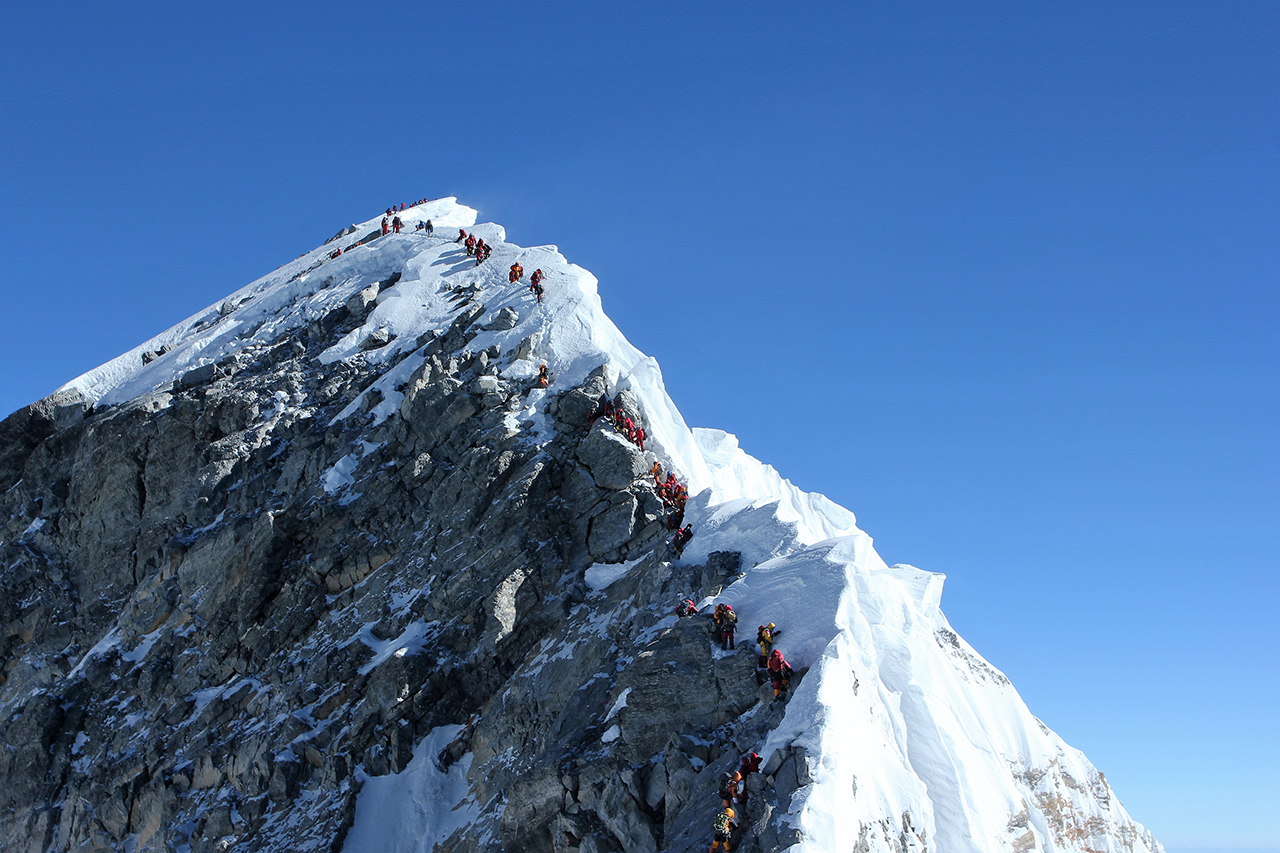
The vertical pitch close to the summit of Mt Everest, traditionally known as The Hillary Step and the last, major challenge for climbers en route to the summit, has changed.
The famous 12m rock face, named after Sir Edmund Hillary following his historic climb of the world’s highest mountain in 1953, appears to have collapsed as a result of the 2015 Nepal earthquake.
Keynote speaker, Dawa Steven Sherpa, told the recent Sustainable Summits conference in Aoraki/Mt Cook, that the former ‘step’ is now more of a ramp. However, speaking to Wilderness, he said this was a particularly snowy year on Everest so what exactly has happened is not yet clear.
“To really assess how much of the rock has fallen off we need to see it with less snow. Nevertheless, for this climbing season a number of climbers reported that the Hillary Step was a ramp rather than an actual face.”
The apparent change has significant ramifications for climbing expeditions, says Dawa, who is managing director of Asian Trekking, a board member of the Expedition Operator’s Association Nepal and an internationally regarded climbing environmentalist.
A major issue on Everest has been congestion at the Hillary Step, with climbers only able to move in one direction, and at crowded times waiting up to two or three hours. “There were a lot of people getting frostbite, running out of oxygen and yes, also deaths. We were exploring the option of putting a ladder on the side of the face, so that people going up could climb the Hillary Step and those coming down would descend the ladder.
“If it is less vertical now and more of a ramp, it will be easier for climbers to get past each other, and they can move up and down at the same time.”
Helpful as this may be, for the Sherpas the news is bittersweet, says Dawa. “We don’t want to lose our iconic mountain landmarks and the Hillary Step is such an important part of climbing Everest.”
He is also surprised not more people have picked up on the news. “The reason might be the lack of clear photographic evidence, because of the snow.”