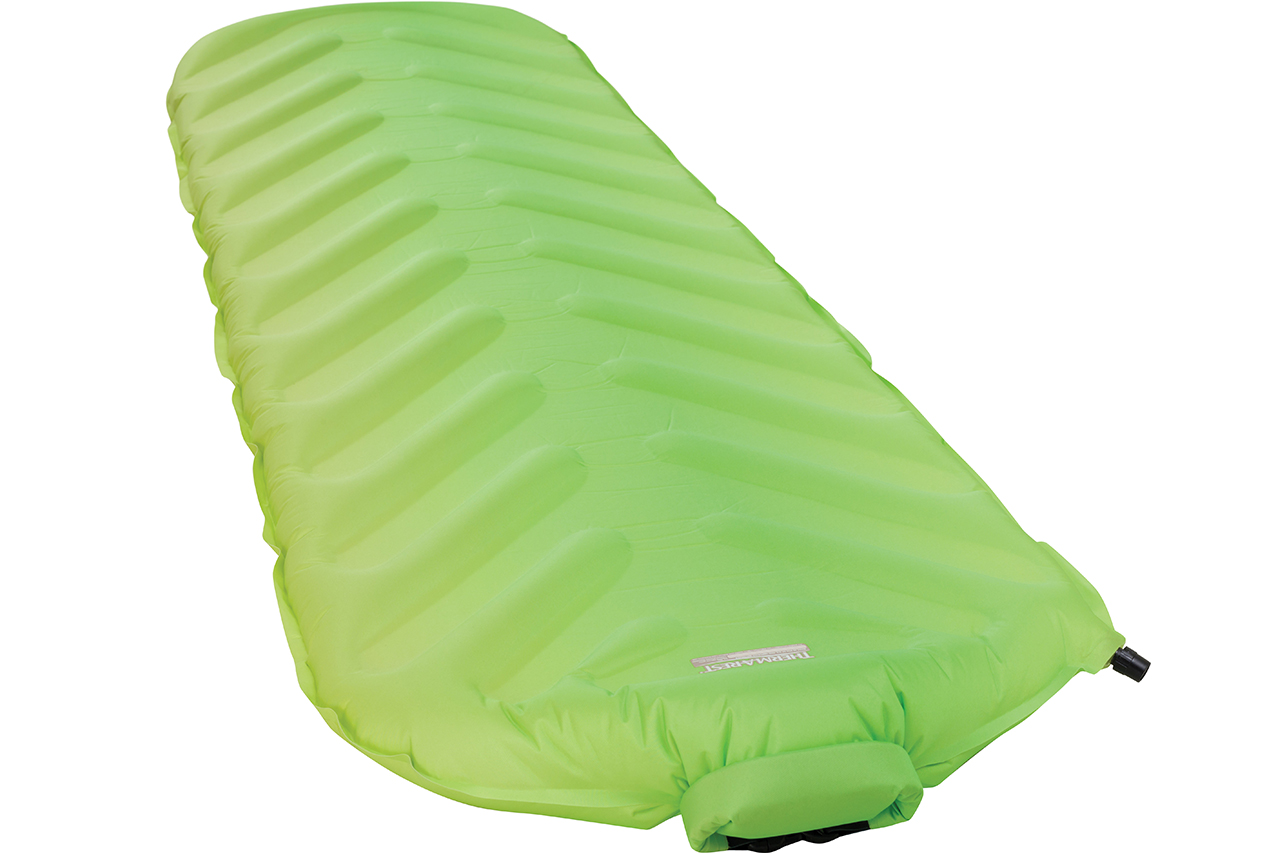
Fill
There are numerous fills – high-density open-cell foam, down, synthetic and plain air – wrapped in a waterproof nylon shell. Anti-fungal treatments will prevent fungus and bacteria from growing inside the mat – caused by moist breath. Some foam-filled sleeping mats are die-cut or horizontally cored to reduce their weight.
Fabrics and finishes
Fabrics are patterned and coated to provide a modicum of grip to prevent the user sliding off during the night. They are DWR-coated to provide water-resistance.
Inflation
Many mats are self-inflating – drawing the air in as the mat regains its shape. They only require a few puffs at the end to reach the desired firmness. Synthetic and down filled mats often require a pump sack to ensure moisture from your breath doesn’t cause mould to grow inside. Air-filled models only need your lungs to inflate.
Valve
Controls the airflow in and out of the mat. Some mattresses have two valves with one used to inflate and the other to deflate. A new wide-opening valve design can inflate/deflate the mattress in seconds.
Thickness
Thickness correlates directly to warmth (measured as an R-value). Advances in materials and fills have allowed manufacturers to provide ever-thicker mattresses at ever-lighter weights. It’s not uncommon to see tramping mats of more than 50mm thickness and weighing just a few hundred grams.
Shape and size
Most mats come in several sizes – short, regular (or medium) and large. They can be tapered to save weight, bulk and to make laying two mats side-by-side easier. Shorter, tapered models are perfect for summer camping. Winter models are full-length and insulated. Prices vary depending on size.
R-value
R-values measure a substance’s thermal resistance; its ability – or inability – to allow heat transfer from one surface to another. Usually between 2 and 7, R-values are an important measure for sleeping mats; the larger the number, the greater its ability to keep you warm. To be truly thermo-neutral (no reduction of core temperature) at 0° on the ground, the R-value should be at least 5.
Storage
Keeping the mat rolled up for lengthy periods will compromise its ability to self-inflate as well as compress the insulation, making it less effective. Store the mat in a cool, dry place, unrolled, with the valve open.
Now you know what to look for, it’s time to choose a model…

Therm-A-Rest NeoAir XTherm $429.99 (reg)
|

Therm-A-Rest MondoKing 3D $399.99 (lge)
|

Therm-A-Rest Neo-Air XLite $399 (reg)
|
 Therm-A-Rest NeoAir Camper SV $349.99 (lge) Therm-A-Rest NeoAir Camper SV $349.99 (lge)Basecamp mattress, SpeedValve technology, auto-reversing deflating valve, stuff sack, repair kit. R-value 2.2 Packed size 27x15cm Dimensions 63x196cm, 7.6cm thick Weight 1050g.  |

Sea to Summit Comfort Plus Insulated $339.99
|
 Therm-A-Rest Trail King SV $299.99 (reg) Therm-A-Rest Trail King SV $299.99 (reg)Self-inflating, AirFrame construction alternates foam and air channels, SpeedValve technology, stuff sack. R-value 1.8 Packed size 20x28cm Dimensions 51x183cm, 6.3cm thick Weight 830g. |
 Therm-A-Rest NeoAir Trekker $299 (reg) Therm-A-Rest NeoAir Trekker $299 (reg)Reflective ThermaCapture radiant heat technology, Triangular Core Matrix of 100 insulating cells provide stability, repair kit, stuff sack. R-value 3.2 Packed size 23x11cm Dimensions 51x183cm, 6.3cm thick Weight 510g. |

Exped Downmat 7 $279.90 (med)
|

Therm-A-Rest ProLite Plus $254.99 (reg)
|

Therm-A-Rest Trail Pro $249.99 (reg)
|

Sea to Summit Ultralight Insulated $229.99 (reg)
|

Exped Synmat UL $219.99 (med)
|

Klymit Insulated Static V $199.95
|

Macpac Insulated Air Core $189.95 (std)
|

Klymit Inertia X Frame $179.95
|

Exped Synmat UL Lite $159.99
|

Therm-A-Rest Z-Lite SOL $114.99 (reg)
|

Therm-A-Rest Ridge-Rest SOLite $74.99 (reg)
|