They brighten up the alpine environment in summer, were traditionally used to make gaiters and rain cloaks and have many species. Meet the mountain daisy.
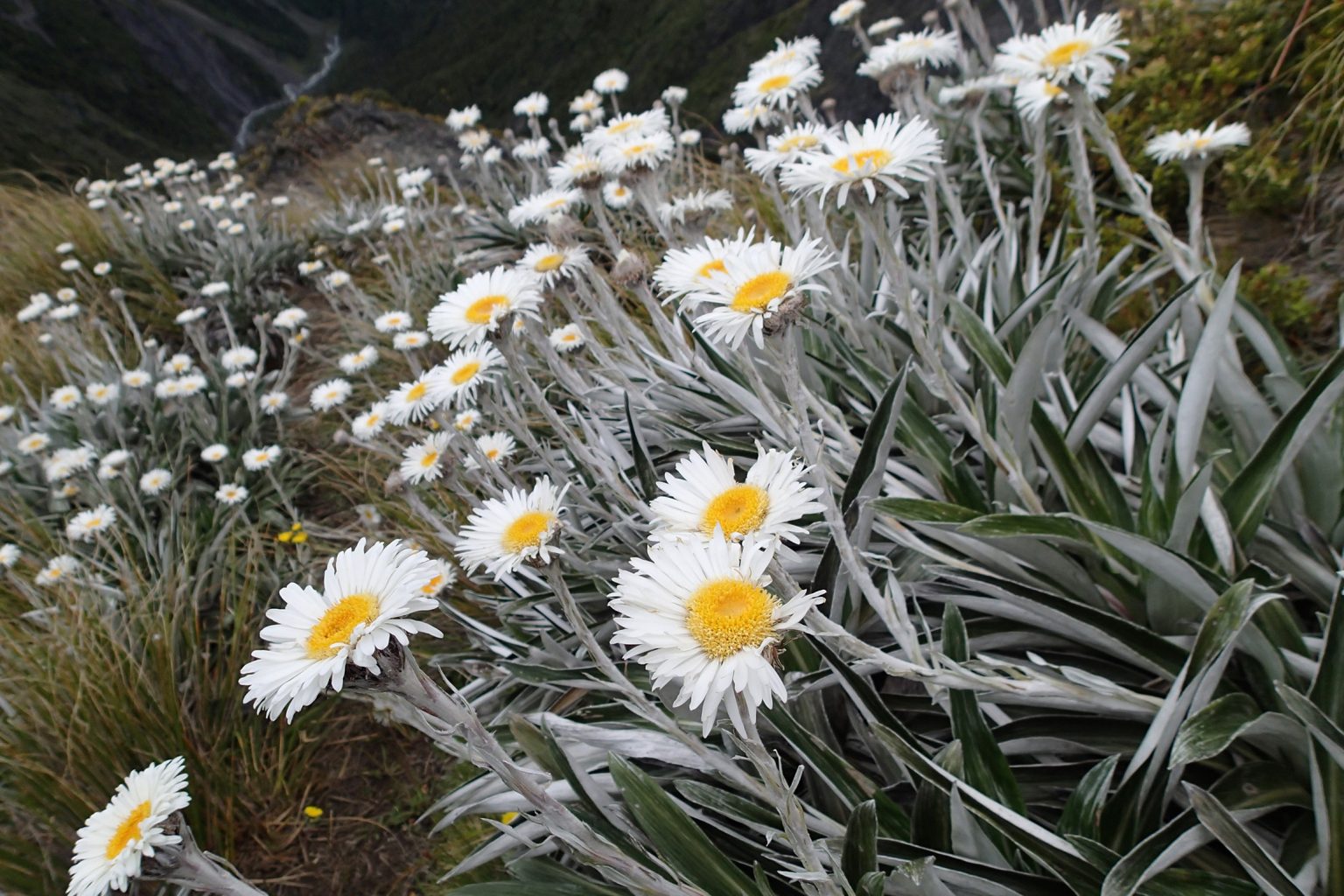
One of the most magnificent sights in summer is a hillside of mountain daisies in flower. The daisies are most likely Celmisia, the third largest genus of plants in Aotearoa (behind Hebes in genus Veronica and a sedge genus called Carex).
Celmisia evolved in New Zealand and then made their way to Australia. New Zealand has 60 species (expanding to 78 once you account for the varieties and subspecies), whereas Australia has eight.
Celmisia have a huge variety of growth forms, leaf shapes, hairiness and habitat, but they are united in their flowers. Like all daisies, a Celmisia flowerhead is really a big cluster of individual flowers grouped together to mimic one giant flower. These individual flowers come in two kinds: the outside ring of ray florets are typically white (rarely pink or yellow tinged) and the central disc florets are yellow. Celmisia produce a single flowerhead on the end of each stalk, and depending on the species, these flowerheads can be as small as your thumbnail or as large as your hand.
Tikumu is the name given to the largest Celmisia species (C. semicordata), a taonga species for Ngāi Tahu. Traditionally, the large impervious leaves, up to 50cm long, were used to make a range of garments including tāhau taupā (gaiters) and pōkeka tikumu (rain cloaks). Tūhoe used puakaito (C. spectabilis) for perfume. Early European settlers used C. angustifolia and C. prorepens as a tobacco substitute and the cotton-like hairs from the underside of other species as a wound dressing.
Celmisia play an important role in the alpine ecosystem and can form a dominant component of alpine herbfields. Visit Mt Burns in Southland to see 20 different species on a single mountainside.
Celmisia host a wide variety of insects, from caterpillars to beautiful painted-wing flies whose larvae burrow into the ripening seeds. New Zealand’s native butterflies, moths, flower beetles, bees and flies feed on the flowerheads and act as pollinators. Kea frequently rip out the flowerheads of the larger species and eat the seeds and insect larvae within, while takahē and kākāpō chew the leaf bases of some species, leaving shredded leaves in their wake. Unfortunately, introduced deer, tahr, goats and chamois also eat Celmisia and are contributing to a declining conservation status for a few species.
As a predominantly alpine genus, most species are found in the South Island. However, the volcanic plateau of the central North Island has four species, and the large white mats of flowering C. incana on the slopes of Ruapehu are a site to behold. Although they are called mountain daisies, some are coastal; C. lindsayi cloaks the sea cliffs at Nugget Point in the Catlins, and a variety of C. major is found on coastal cliffs around Auckland. The top of the South Island has the most endemic species, while Westland and Canterbury have the most overall. Most alpine tramps will give you the opportunity to see at least five if not 10 or more Celmisia.
Today you can buy some Celmisia species from specialist garden centres, but they should never be removed from the wild as some are rare and threatened.